Tuesday, February 24, 2015

Huckleberry Finn Study Guide Ch. 1-15

AGENDA:

John Legend's Oscar acceptance speech

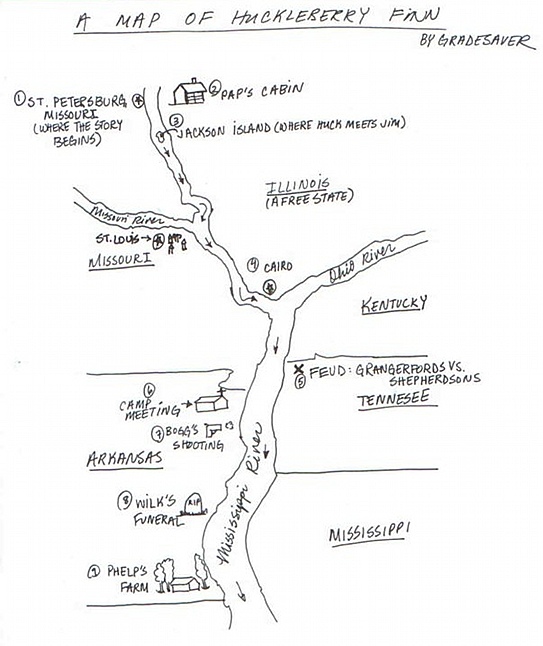
Review Themes and Historical Context and MAP

Reading Pointers for Sharper Insights

                
To better appreciate The Adventures of Huckleberry Finn and understand why most critics believe it is the quintessential American novel, we need to look at some of the concepts that Twain explores.
  1. How does the relationship between Huck and Jim change throughout the novel and why is this significant?
  2. How do the raft and the shore symbolize civilization and freedom, respectively? What does Twain's message about civilization seem to be? Is he cynical about what civilization has brought to America?
  3. What is the correlation between Huck's adventures on shore and his loss of innocence?
  4. Examine Twain's development of the following motifs:
  5. How do the various dialects contribute to the authenticity and feel of the text?
  6. How is the text influenced by having the story told through the eyes of the main character, Huck Finn, a twelve-year old, unschooled, mischievous boy?
  7. What are Twain's criticisms of traditional concepts of religion?
  8. Notice the objects of Twain's satire:
    • sentimentality (being influenced more by emotion than reason) and gullibility (being easily tricked, cheated, or fooled)
    • the average man
    • romantic literature, with its mournful subject matter in poetry and its ridiculous plots in novels
    • a code of honor that results in needless bloodshed and complexities

In groups begin work on Study Guides discussing questions and close reading of passages.  Annotate text.  Explore themes.

HMWK:  Spelling  next 2 sections for Friday quiz
Continue to read----Test  Ch. 1-30  Friday quiz
Finish book for Tuesday, March 3

Themes in Huck Finn

Themes


The Adventures of Huckleberry Finn, one of the central works of American literature and a worldwide bestseller, traces the moral education of a young boy whose better impulses overcome both self-interest and the negative forces of his culture. Huck, a homeless boy whose only relative is his disreputable father, is taken in by a respectable widow who seeks to educate him. She forces him to go to school, but Huck dislikes being "so cramped up and sivilized [sic] as they call it." His father abducts him, and Huck prefers the freedom of his father's shack to the constraint of more genteel surroundings.
Freed from civilizing influences and placed in the company of his father, a vicious racist who boasts of his own illiteracy, Huck seems like a poor candidate for moral growth. But when Pap Finn nearly kills the boy during an alcoholic delirium, Huck escapes and meets the runaway slave Jim, who provides him with the opportunity to make a significant moral choice. Huck has been shaped not only by his father's view that one should act out of self-interest, but also by his society's belief that God's law mandates slavery. As he protects Jim, Huck feels certain that he will go to hell. Nonetheless, he transcends his upbringing and learns to value essential human bonds of trust beyond his own interest. Throughout the novel the boy witnesses a variety of human corruption, pretension, and violence, but maintains his integrity through his ability to identify with others.
The Walter Scott, the derelict steamer named after the enormously popular author of historical romances, suggests an attitude toward the ideals of chivalry as they are practiced in the American South. These ideals are acted out as murderous fantasies by the Grangerfords, who impress Huck with their refinement and "culture" (plaster parrots and morbid art) but are involved in a bloody feud, and by Col. Sherburn, who shoots down an unarmed man for insulting him. Society's institutions are built on some of the same illusions Tom draws from books, with terrible consequences. Religion is employed in the service of slavery, and Huck has to overcome his "conscience" in order to act morally toward Jim.

The Adventures of Huckleberry Finn Themes

 
In The Adventures of Huckleberry Finn both Huck and the runaway slave Jim are in flight from a society which labels them as outcasts. Although Huck has been adopted by the Widow Douglas and been accepted into the community of St. Petersburg, he feels hemmed in by the clothes he is made to wear and the models of decorum to which he must adhere. But he also does not belong to the world Pap inhabits. Although he feels more like himself in the backwoods, Pap's drunken rages and attempts to control him force Huck to flee. At the end of the book, after Jim has been freed, Huck decides to continue his own quest for freedom. "I reckon I got to light out for the Territory ahead of the rest, because Aunt Sally she's going to adopt me and sivilize me, and I can't stand it. I been there before." Huck is clearly running from a civilization that attempts to control him, rather than running in pursuit of something tangible. He is representative of the American frontiersman who chooses the unknown over the tyranny of society.
As a slave, Jim has likewise been denied control over his own destiny, and he escapes to prevent being sold down to New Orleans, away from his wife and children. But Jim is chasing a more concrete ideal of freedom than Huck is. For Jim, freedom means not being a piece of property. Jim explicitly expresses his desire to be free as they approach Cairo and the junction with the Ohio River: "Jim said it made him all over trembly and feverish to be so close to freedom." But after they pass Cairo in the confusion of a foggy night, Jim's quest for freedom is thwarted and he must concentrate on survival. After Jim's capture, Tom and Huck attempt to free him in a farcical series of schemes that actually make escape more difficult and dangerous. Huck indicates that a simple removal of the board that covers the window would allow Jim to escape, but Tom declares that is too easy. "I should hope we can find a way that's a little more complicated than that, Huck Finn," Tom says. After Jim escapes and is recaptured, Tom reveals that he has been free all along. Miss Watson had died and left him free in her will. The irony of freeing a free man has concerned many critics, who believe Twain might have been commenting on the failure of Reconstruction after the Civil War.

Conscience
Huck's main struggle in the book is with his conscience, the set of morals with which he has been raised. As they begin to approach Cairo, and Jim looks forward to his freedom, Huck says his conscience "got to troubling me so I couldn't rest." He rationalizes that he didn't lure Jim away from his owner, but "conscience up and says every time, 'But you knowed he was running for his freedom, and you 'could 'a' paddled ashore and told somebody.'" During this scene he wakes up to the fact that he is helping a slave gain freedom, something he has been brought up to believe is wrong. So in an attempt to relieve his guilt, he sets off for shore, telling Jim he is going to find out if they have passed Cairo, but really intending to turn Jim in. When he meets up with two men looking for a runaway slave, he confronts a true test of conscience, and fails, in his eyes. The two men ask him about the man on board, and Huck protects Jim by making up an elaborate tale about his father who is dying of smallpox, a highly contagious disease. When he returns to the raft, Jim rejoices in his cover-up, but Huck instead is "feeling bad and low, because I knowed very well I had done wrong." He decides that he is naturally bad, and that he only did what made him feel better. Not being able to analyze his actions, Huck fails to recognize that he has taken a stand against a morally corrupt society. Later, after Jim has been turned in by the King and Duke, Huck must again wrestle with his conscience as he decides to play an active role in freeing Jim. Up until this point he had only protected Jim from discovery; now he must help Jim escape, an even more serious crime. But rather than let his "conscience" guide him, Huck listens to his heart, which tells him that Jim is a human being, not property. He turns his back forever on society's ethics and decides he'd rather "go to hell" than turn his back on Jim. Through Huck, Twain attacks that part of the conscience that unquestioningly adheres to society's laws and mores, even when they are wrong.

Race and Racism
Probably the most discussed aspect of Huck Finn is how it addresses the issue of race. Many critics agree that the book's presentation of the issue is complex or, some say, uneven. No clear-cut stance on race and racism emerges. Despite the fact that Huck comes to respect Jim as a human being, he still reveals his prejudice towards black people. His astonishment at Jim's deep feelings for his family is accompanied by the statement, "I do believe he cared just as much for his people as white folks does for their'n. It don't seem natural, but I reckon it's so." And even after he has decided to help free Jim, Huck indicates that he still does not see black people overall as human beings. When Aunt Sally asks "Tom Sawyer" why he was so late in arriving, he tells her the ship blew a cylinder head. "Good gracious! Anybody hurt?" she asks. "No'm. Killed a nigger." "Well, it's lucky; because sometimes people do get hurt," she responds. As some critics have pointed out, Huck never condemns slavery or racial prejudice in general but seems to find an exception to the rule in Jim. Nevertheless, the fact that Huck does learn to see beyond racial stereotypes in the case of Jim is a profound development, considering his upbringing. He lived in a household with the Widow Douglas and Miss Watson where slaves were owned. And Pap's rantings over a free black man indicate his deep racial prejudice. When confronted with the fact that a free black man was highly educated and could vote, Pap decides he wants nothing to do with a government that has allowed this to happen. He wants the free man, whom he calls "a prowling, thieving, infernal, white-shirted free nigger," to be sold at auction. In other words, all black people are slaves, white man's property, in his eyes. Such are the views on race with which Huck has been raised. But there is no agreement as to what Twain's message on the subject of race is. While some critics view the novel as a satire on racism and a conscious indictment of a racist society, others stress the author's overall ambivalence about race. Critics have had a difficult time reconciling the stereotypical depictions of Jim and other slaves in the book with Huck's desire to free Jim.

Themes Developed
The Adventures of Huckleberry Finn, one of the central works of American literature and a worldwide bestseller, traces the moral education of a young boy whose better impulses overcome both self-interest and the negative forces of his culture. Huck, a homeless boy whose only relative is his disreputable father, is taken in by a respectable widow who seeks to educate him. She forces him to go to school, but Huck dislikes being "so cramped up and sivilized [sic] as they call it." His father abducts him, and Huck prefers the freedom of his father's shack to the constraint of more genteel surroundings.
Freed from civilizing influences and placed in the company of his father, a vicious racist who boasts of his own illiteracy, Huck seems like a poor candidate for moral growth. But when Pap Finn nearly kills the boy during an alcoholic delirium, Huck escapes and meets the runaway slave Jim, who provides him with the opportunity to make a significant moral choice. Huck has been shaped not only by his father's view that one should act out of self-interest, but also by his society's belief that God's law mandates slavery. As he protects Jim, Huck feels certain that he will go to hell. Nonetheless, he transcends his upbringing and learns to value essential human bonds of trust beyond his own interest. Throughout the novel the boy witnesses a variety of human corruption, pretension, and violence, but maintains his integrity through his ability to identify with others.
The Walter Scott, the derelict steamer named after the enormously popular author of historical romances, suggests an attitude toward the ideals of chivalry as they are practiced in the American South. These ideals are acted out as murderous fantasies by the Grangerfords, who impress Huck with their refinement and "culture" (plaster parrots and morbid art) but are involved in a bloody feud, and by Col. Sherburn, who shoots down an unarmed man for insulting him. Society's institutions are built on some of the same illusions Tom draws from books, with terrible consequences. Religion is employed in the service of slavery, and Huck has to overcome his "conscience" in order to act morally toward Jim.

Huck Finn and the Six Pillars of Character

AGENDA:

Introduce the six pillars of character in relation to Huck Finn

https://charactercounts.org/sixpillars/

Huck Finn Historical Background

INTRODUCTION

In the U.S., before 1860, almost everyone in the South and many in the North thought that slavery was a good institution. Most were taught in their churches that it was sanctified by the Bible and ordained by God. The abolitionists were a vocal minority in the North. While they had control of a few states their ideals were not popular with most Americans. In 1860, Abraham Lincoln was elected on a platform that would allow slavery to exist in the South; he just didn't want it to extend to any new states that were to be formed from the Western territories. In the community in which Huck Finn grew up, as in all areas of the South, a belief in the righteousness of slavery was an important shared value.
The River

The Mississippi River is the largest river in the United States flowing 2,348 miles from North to South. It begins in Minnesota and empties into the Gulf of Mexico below New Orleans. The Mississippi's chief tributaries are the Ohio and Missouri Rivers. The Mississippi has been a major transportation artery of the United States since before the Louisiana Purchase. During the period of this story, steamboats were the principal means of transportation on the Mississippi.

Rivers have long served as symbols for freedom, escape, and new beginnings. In his writings, Mark Twain frequently used the Mississippi to help his readers visualize these concepts.

Historical Background:

The United States is arguably the greatest democracy in the world. It was created by the first popular democratic revolution and inspired the French Revolution. Together, the American and French revolutions have served as inspiration for many other modern democratic revolutions, extending through to the Arab Spring of 2011. However, in the Continental Congress and the Constitutional Convention, the founding fathers of the United States found that a bargain with a peculiar type of devil was required to establish the new nation. That devil was slavery. In 1776, leaders of the Southern states saw that Great Britain would soon outlaw slavery in its colonies — it did so in 1833. In the Continental Congress, they demanded that the institution of slavery be protected as the price for agreeing to join the rebellion. This is why the Congress deleted from Jefferson's draft of the Declaration of Independence a reference to slavery as an evil institution foisted on the colonies by the English king. The Constitution continued this bargain with the devil, failing to recognize slaves as citizens and protecting the property rights of slaveholders. In the Constitution, the abominable international slave trade was protected until 1801.

Until 1857, were an escaped slave to reach a free state, one that that did not recognize the "right" of one individual to own another, the slave would be considered free. In 1857, however, the U.S. Supreme Court determined that the Fugitive Slave Law required public officials in the free states to catch, hold and then return runaway slaves to their owners. This ruling was intolerable to fair minded people in the North and helped to ignite the Civil War.

Another law that worked against the elimination of slavery made it a crime to teach slaves to read. Slaveholders knew that if slaves became educated they would be more difficult to control and more likely to rebel. Huck's companion on his adventure, an escaped slave named Jim, was illiterate. Jim and his family communicated with each other through letters written by others on their behalf. This is a common practice when many people cannot read. See Learning Guide to Roots Vol. IV and a short excerpt from Frederick Douglass' autobiography detailing his decision to learn to read at whatever cost.


Slavery
  The issue of slavery threatened to divide the nation as early as the Constitutional Convention of 1787, and throughout the years a series of concessions were made on both sides in an effort to keep the union together. One of the most significant of these was the Missouri Compromise of 1820. The furor had begun when Missouri requested to enter the union as a slave state. In order to maintain a balance between free and slave states in the union, Missouri was admitted as a slave state while Maine entered as a free one. And although Congress would not accept Missouri's proposal to ban free blacks from the state, it did allow a provision permitting the state's slaveholders to reclaim runaway slaves from neighboring free states.

The federal government's passage of Fugitive Slave Laws was also a compromise to appease southern slaveholders. The first one, passed in 1793, required anyone helping a slave to escape to pay a fine of $500. But by 1850, when a second law was passed, slaveowners had become increasingly insecure about their ability to retain their slaves in the face of abolitionism. The 1850 Fugitive Slave Law increased the fine for abetting a runaway slave to $1000, added the penalty of up to six months in prison, and required that every U.S. citizen assist in the capture of runaways. This law allowed southern slaveowners to claim their fugitive property without requiring them to provide proof of ownership. Whites and blacks in the North were outraged by the law, which effectively implicated all American citizens in the institution of slavery. As a result, many who had previously felt unmoved by the issue became ardent supporters of the abolitionist movement.

Among those who were outraged into action by the Fugitive Slave Law was Harriet Beecher Stowe whose novel Uncle Tom's Cabin (1852) galvanized the North against slavery. Dozens of slave narratives—first hand accounts of the cruelties of slavery—had shown white Northerners a side of slavery that had previously remained hidden, but the impact of Stowe's novel on white Northerners was more widespread. Abraham Lincoln is reported to have said when he met her during the Civil War, "So you're the little lady who started this big war." White southerners also recognized the powerful effect of the national debate on slavery as it was manifested in print, and many southern states, fearing the spread of such agitating ideas to their slaves, passed laws which made it illegal to teach slaves to read. Missouri passed such a law in 1847.
Despite the efforts of southerners to keep slaves in the dark about those who were willing to help them in the North, thousands of slaves did escape to the free states. Many escape routes led to the Ohio River, which formed the southern border of the free states of Illinois and Indiana. The large number of slaves who escaped belied the myths of contented slaves that originated from the South.

Reconstruction
Although The Adventures of Huckleberry Finn takes place before the Civil War, it was written in the wake of Reconstruction, the period directly after the Civil War when the confederate states were brought back into the union. The years from 1865 to 1876 witnessed rapid and radical progress in the South, as many schools for blacks were opened, black men gained the right to vote with the passage of the Fifteenth Amendment in 1870, and the Civil Rights Act of 1875 desegregated public places. But these improvements were quickly undermined by new Black Codes in the South that restricted such rights. White southerners felt threatened by Republicans from the North who went south to help direct the course of Reconstruction. Most galling was the new authority of free blacks, many of whom held political office and owned businesses. While prospects did improve somewhat for African Americans during Reconstruction, their perceived authority in the new culture was exaggerated by whites holding on to the theory of white superiority that had justified slavery.

In response to the perceived threat, many terrorist groups were formed to intimidate freed blacks and white Republicans through vigilante violence. The Ku Klux Klan, the most prominent of these new groups, was formed in 1866. Efforts to disband these terrorist groups proved ineffective. By 1876, Democrats had regained control over the South and by 1877, federal troops had withdrawn. Reconstruction and the many rights blacks had gained dissipated as former abolitionists lost interest in the issue of race, and the country became consumed with financial crises and conflicts with Native Americans in the West. Throughout the 1880s and 1890s, new Jim Crow laws segregated public spaces in the South, culminating in the Supreme Court's decision in the case Plessy v. Ferguson in 1896, which legalized segregation.

Minstrel Shows
As the first indigenous form of entertainment in America, minstrel shows flourished from the 1830s to the first decade of the twentieth century. In the 1860s, for example, there were more than one hundred minstrel groups in the country. Samuel Clemens recalled his love of minstrel shows in his posthumously published Autobiography, writing, "If I could have the nigger show back again in its pristine purity and perfection I should have but little further use for opera." His attraction to blackface entertainment informed The Adventures of Huckleberry Finn, where, many critics believe, he used its humorous effects to challenge the racial stereotypes on which it was based.

Minstrel shows featured white men in blackface and outrageous costumes. The men played music, danced, and acted burlesque skits, but the central feature of the shows was the exaggerated imitation of black speech and mannerisms, which produced a stereotype of blacks as docile, happy, and ignorant. The shows also depicted slavery as a natural and benign institution and slaves as contented with their lot. These stereotypes of blacks helped to reinforce attitudes amongst whites that blacks were fundamentally different and inferior. The minstrel show died out as vaudeville, burlesques, and radio became the most popular forms of entertainment.

Map of Huck Finn

Monday, February 23, 2015

Huckleberry Finn

AGENDA:

Continue discussions of Huckleberry Finn

Discussion questions Huckleberry Finn

1. The Widow Douglas and her sister, Miss Watson, are both trying to “sivilize” Huck. Compare and contrast their attitudes toward Huck. What method does each one use in her efforts to turn him into a “respectable” citizen? How do those methods differ? How are they the same? Cite examples from the novel to support your argument.
2. Analyze the scene where Huck flips the spider into the candle. Why does he feel that this would bring him bad luck? How does this scene foreshadow superstition in the novel? Support your answer with examples from the novel.
3. Twain chooses a 13-year-old boy as narrator for his novel. In what way does this help to accomplish Twain’s purpose? Discuss the ways in which a young, innocent narrator can make a profound statement about the hypocrisy of his society. Explain your answer.
Chapters 2-3
1. Although Huck Finn and Tom Sawyer are presented as contrasting characters in the novel, they are alike in many ways. Compare and contrast the characters of Huck and Tom, giving examples from the novel to support your argument.
2. Analyze Jim’s idea that he has been ridden around the world by witches. Why was he proud? Were the slaves the only ones who believed Jim’s story? Does Huck believe it? Explain your answer.
3. Analyze the role of respectability in Tom Sawyer’s supposedly lawless gang. Why is it mandatory for each member to have a respectable family? Examine the idea that Huck, who has had more experience with breaking the law than any of the others, comes close to being excluded from the gang.
Chapters 4-5
1. Superstition is a recurring theme in the novel. Analyze Twain’s satiric treatment of the hairball scene. Examine the answers Huck receives about his life. How does Jim keep the hairball’s comments believable?
2. Analyze the relationship of Huck and his father. In what ways was he different from the ideal? How did this influence Huck’s feelings about society as a whole? Explain your reasoning.
3. Analyze Judge Thatcher’s reactions to Huck’s request to take his money. Why did the judge exchange one dollar for six-thousand dollars? Was he cheating Huck? Explain your answer.
Chapters 6-7
1. Huck seems to adapt to almost any situation. He has become accustomed to civilized life with the Widow Douglas. Later he finds life in the woods carefree and easy. Analyze the character of Huck. Discuss possible reasons for his adaptability to different situations. Use examples from the novel to support your argument.
2. In the novel Pap does not appear to be a civilized man. Discuss ways in which he does, however, fit into the larger society. Does he compare to the Widow Douglas in any way? Explain your answer.
3. Huck wishes Tom Sawyer were with him to add some “fancy touches” to his plan of escape. Discuss the difference between Huck’s scheme of faking his death and the attack on the “A-rabs” and “Spaniards” in Chapter 3. Cite examples from the novel to support your ideas.
Chapters 8-9
1. Huck’s most poetic language is prompted by a severe thunderstorm on the island. Discuss the reasons for this. In what way does the storm inspire him? Why is he not afraid of the storm? Use examples from the novel to support your argument.
2. If Huck keeps Jim’s secret of his escape, people will call him a “low-down Abolitionist.” In what way are those words more effective when spoken by a young narrator? Explain the irony in Huck’s statement. What is Twain’s message about the hypocritical values of his society? Explain your answer with examples from the novel.
3. Miss Watson could sell Jim for eight hundred dollars. He, therefore, feels rich because he owns himself. Explain Twain’s use of satire in Jim’s statement . What was Twain’s attitude toward slavery in this passage? Explain your answer.
Chapters 10-11
1. Huck’s growing concern for Jim’s welfare is evident in many ways. Discuss the events where this concern is reflected in Huck’s behavior. In what ways does he protect Jim from danger? Cite examples from the novel to support your argument.
2. Huck’s ability to tell a story in order to get himself out of a “tight” situation is one of his greatest strengths. How does this apply to his encounter with Mrs. Judith Loftus? What does he do when she realizes he is a boy? Explain your answer.
3. When Huck curls up the snake at the foot of Jim’s blanket, he does not tell Jim that he has done it. What is his reason for keeping his little joke a secret? What lesson does Huck learn from it? How would Jim have felt if Huck would have told the truth? Discuss your answer.
Chapters 12-13
1. Huck’s journey on the river is filled with adventures, but it is also a symbolic journey. What does his journey symbolize? How does his relationship with Jim tie in to the symbolism? Compare the symbolism of the shore to that of the river. Use examples from the novel to support your view.
2. The Adventures of Huckleberry Finn is often referred to as the embodiment of mythological characteristics. In what way does the journey down the river represent these characteristics? How is Huck’s escape from society and his love for the natural world of the river incorporated into this idea? Explain your answer.
3. Twain uses satire to expose people’s ability to rationalize their wrongdoings. In what way does Twain employ that device in the incident where Huck “lifts chickens” and “borrows watermelons”? What do the words “lifts” and “borrows” connote? Give examples from the novel to support your argument.
Chapters 14-15
1. The relationship between Huck and Jim is brought into focus in these chapters. How does their frightening separation in the fog draw them closer together? How do they feel about each other at this point in the novel? Give examples from the novel to support your viewpoint.
2. Huck and Jim carry on a lengthy conversation about royalty. In what way does Twain satirize royalty in these chapters? What is Jim’s opinion of King Solomon? Why does he feel that way? Give examples from the novel to support your argument.
Chapters 16-17
1. Huck makes a moral decision concerning Jim’s freedom in Chapter 16. How does this decision affect Huck as a character in the novel? Discuss the first time in the novel that he made a decision to help Jim escape to freedom. How did the decision affect him then? Cite examples from the novel to support your view.
2. There is irony in the statement Jim makes about stealing his children. In what way is it ironic that Jim’s children belong to someone else? Why did Huck feel it was morally wrong for Jim to claim his children as his own? Give examples from the novel to support your argument.
3. Critics believe Twain stopped writing the novel for a few years after he finished Chapter 16. Why would this have been a difficult place for Twain to continue? How does the setting of the novel change at this point? Explain your answer.
Chapters 18-19
1. Harney Shepherdson and Miss Sophia are victims of the feud between the Grangerfords and the Shepherdsons. Compare and contrast their conflict with that of Shakespeare’s Romeo and Juliet. In what way was their situation the same? How was it different? Was Huck sympathetic with the young couple? Give examples from the novel to support your argument.
2. Twain employs satire throughout the novel to speak out against the hypocrisy and corruption in his society. In what way is the church service, attended by the Grangerfords and the Shepherdsons, an attack on the religion of Twain’s day? How does the hog incident add to the satire? Explain your answer.
3. In these chapters life on the raft is contrasted sharply with the violence and bloodshed Huck has recently encountered on the shore. How does this contrast bring out the theme of freedom in the novel? How does Huck feel about life on the raft? How does Jim feel? Use examples from the novel to support your viewpoint.
Chapters 20-21
1. In the novel Huck continually tells stories to get himself out of tight situations. Why doesn’t this bother Huck’s conscience? In what way is Huck forced to tell a lie? Is Huck morally wrong in doing so? Defend your argument with examples from the novel.
2. It is during a natural phenomenon such as a thunderstorm that Huck uses his most artistic language. Discuss Huck’s feeling about the thunderstorm. Why is he not afraid of the storm? How does this symbolize his life on the river as opposed to life on the shore? Explain your answer.
3. There are many examples of gullibility in the novel. In what way does Twain satirize the gullibility of the people at the camp meeting? How does the king trick them into taking up a collection? Why do they believe him? Support your argument.
Chapters 22-23
1. Twain is satirizing the lynch mob in these chapters. In what way can the individuals in a mob be seen as cowards? Discuss the psychology of a lynch mob. Why is Sherburn successful in breaking up the mob? Cite examples from the novel to support your argument.
2. Through the characters of the duke and the king, Twain is satirizing royalty. What qualities in a king would make him a “rapscallion?” How does Huck’s reference to kings throughout history prove his point? Explain your answer.
3. The relationship between Huck and Jim is growing deeper as the novel progresses. How is Jim’s humanity expressed through the eyes of Huck? How does Jim feel about Huck? How can Huck tell? Explain your answer.
Chapters 24-25
1. In these chapters Twain satirizes the gullibility of the townspeople who believe an imposter like the king, but, ironically, do not believe Dr. Robinson. Write an essay comparing the gullibility of the townspeople to people in today’s world. In what ways are people gullible? What makes them gullible? Explain your answer.
2. Huck has become more critical of the duke and the king than he was in preceding chapters. Why has this change taken place in his character? Explain Huck’s moral development as it relates to previous chapters in the novel. Cite examples from the novel to support your argument.
3. The ultimate sacrifice in the eyes of the townspeople is when the king and the duke give the Wilks girls the whole six thousand dollars. Why do they give it away? What is their motive? What do they hope to gain? Support your argument with examples from the novel.
Chapters 26-27
1. The king and the duke have been involved in several fraudulent schemes along the river. Compare and contrast the Wilks episode to The Royal Nonesuch in the last town. Why does Huck take action against the frauds in the Wilks episode? Why was he merely an observer in The Royal Nonesuch? How do they compare? How are they different? Use examples from the novel to support your argument.
2. The two frauds have supposedly been duped through their sale of the slaves. In what way do the king and the duke judge the slaves by their own standards? In what way do they think the slaves have played a game in order to get away with the money? Defend your argument with examples from the novel.
3. The separation of families through the selling of slaves is a recurrent theme in the novel. What is Twain’s attitude about this controversial issue? Cite at least two examples from the novel that deal with the separation of families and point out the way in which Twain satirizes the issue.
Chapters 28-29
1. The novel is filled with examples of stories Huck tells when he is in a tight situation. In Chapter 28 he decides that truth is better than lies, however. Why does he have a change of heart in this chapter? How does Huck feel about Mary Jane? Does he trust her with the truth? Does he ever lie to her? Why does he depend on lies to get through difficult situations? Cite examples from the novel to support your argument.
2. Throughout the course of the novel, Twain uses descriptions of thunderstorms. Compare and contrast the description of the thunderstorm in Chapter 29 with descriptions in other parts of the novel. How are they the same? How is this one different? Cite examples from the novel to support your argument.
3. Mary Jane is one of Huck’s favorite people in the novel. What qualities does she possess that makes Huck fond of her? How is she different from her sisters? Explain your answer.
Chapters 30-31
1. Huck makes his ultimate moral decision in Chapter 31 of the novel. What is Twain satirizing in this episode? Explain Huck’s natural morality as opposed to society’s morality. Use examples from the novel to support your answer.
2. Twain sheds a slightly different light on the duke in these chapters. What is different about the actions of the duke? How does this make us feel about him? Is the duke less evil than the king? Explain your answer.
3. Huck faces a moral decision to help Jim escape in three different epiodes of the novel. Explain each dilemma and describe how it affects Huck’s development as a character. Cite examples from the novel to support your argument.
Chapters 32-33
1. Twain paints a bleak, depressing picture of the Phelps Plantation. Compare and contrast Huck’s view of life on the plantation to life on the raft. In what way is his view affected by his recent loss of Jim? Cite examples from the novel to support your argument.
2. Huck is shocked when Tom Sawyer tells him he will help steal Jim out of slavery. What does Tom know about Jim and how does that affect his decision? How does Huck view Tom as a member of society? How does he view himself? Support your answer with examples from the novel.
3. Jim acts as an informant in the case of the king and duke’s Royal Nonesuch show. In what way is justice being done? Why do you think Jim is seen in a different light in this section of the novel? Do his actions seem believable? Defend your argument with examples from the novel.
Chapters 34-35
1. The contrasting personalities of Huck and Tom provide the reader with the satiric humor in these chapters. In what way do their personalities contrast? How are Tom’s romantic notions brought out in the plan to free Jim? How does Huck disagree? Cite examples from the novel to support your argument.
2. Tom and Huck disagree on the idea of stealing and borrowing. What does Huck call borrowing? What does Tom consider stealing? When does Tom consider stealing all right? When is it wrong? Support your argument with quotes from the novel.
3. In this section of the novel Tom already knows that Jim has been freed by Miss Watson. In view of this fact, how do you interpret his actions in the plan of escape? Is Tom unusually cruel to Jim by making him wait unnecessarily? Why doesn’t he tell Huck and Jim? Explain your answer.
Chapters 36-37
1. Two different types of morality are demonstrated in the novel. Contrast Huck’s morality with Tom’s. How are they different? Explain the origins of each of the boys’ sense of morality? Cite examples from the novel to support your argument.
2. Twain often satirizes the religious sensibilities of his day through the characters in the novel. In what way is he satirizing Uncle Silas’s prayers with Jim? Do you feel Uncle Silas is being kind to Jim? Why does Jim feel his kindness? Explain your answer.
Chapters 38-39
1. Jim is taken out of his prison to help Huck and Tom with the grindstone. In what way is this humorous incident ironic? Why does Jim go back to his prison? Why doesn’t he leave while he has the chance? Why don’t the boys help him to escape? Explain your answer.
2. Tom often prescribes cruel treatment for Jim in order to carry out his elaborate plan of escape. How does one account for his lack of sensitivity to Jim’s feelings? Is Tom a cruel person? How does Tom treat other people in the novel? Cite examples from the novel to support your argument.
3. Tom works on a coat of arms for Jim. Does he have sufficient knowledge of this subject? Is his knowledge limited? Why doesn’t he give Huck the definitions of “fess” and “bar sinister”? Support your answer with examples from the novel.
Chapters 40-41
1. Jim unselfishly gives up his freedom so they can get a doctor for Tom. Does this act seem consistent with Jim’s character? Why does he do it? Describe one other instance in the novel where Jim is unselfish. Cite examples from the novel to support your argument.
2. Tom is happy when they reach the raft in spite of the fact that he has a bullet in his leg. Why is he happy? Why doesn’t he want to see a doctor? What instructions does Tom give Huck about the doctor? How is this a part of Tom’s plan of escape? Explain your answer with examples from the novel.
3. Huck invents stories throughout the novel to get himself out of tight situations. Is Huck’s story to the doctor as believable as his stories have been in the past? Does the doctor doubt Huck? Are there any flaws in his story. Use examples from the novel to support your argument.
Chapters 42-43
1. Jim is often referred to as a noble character in the novel. In what way is his nobility shown in the last few chapters. How does he show courage by helping the doctor? Why does he do it? What price does he pay? Support your answer with examples from the novel.
2. The men who are attending to Jim want to hang him as an example to other slaves who might attempt to escape. Why do they decide against it? How does this incident satirize the morality of the men? Cite examples from the novel to explain your answer.
3. At the end of the novel Huck wants to escape so Aunt Sally will not try to “sivilize” him. How has the meaning of the word “sivilize” changed for Huck? In what way has Huck grown as a character in the novel? Give examples from the novel to support your argument.


Go over 19th century packets


Friday, February 13, 2015

Vocabulary Huck Finn

Vocabulary Huck Finn


Vocabulary for The Adventures of Huckleberry Finn Chapters I- VII


1.     big-bug (noun) - an important person
2.     bullyrag (verb)- browbeat, harass
3.     delirium tremens (verb)- violent hallucinations caused by excessive drinking
4.     pungle (verb) - pay up
5.     raspy (adjective) - harsh, irritating
6.     skiff (noun)- a small, light rowboat
7.     slouch (noun)- a soft, wide-brimmed hat
8.     ingots (Noun)- a piece of metal formed from a mold.
9.     sumter (noun) - a pack animal
10.  temperance (adjective)- self-control, especially in drinking

Vocabulary for The Adventures of Huckleberry Finn Chapters VIII - XVI

1.     chucklehead (adjective)- fool, blockhead
2.     contrived (verb)- planned, devised
3.     corn-pone - a cheap kind of corn bread
4.     crawfish (verb)- to back out
5.     dolphin (dauphin) (noun) - the eldest son of a king
6.     fan-tods (adjective)- a state of nervousness or fear
7.     haggled (verb)- cut in a clumsy or awkward way
8.     pilot-house (noun)- a compartment on a steamboat in which the pilot works
9.     rapscallions - rascals, scoundrels
10.  wigwam - a hut built for shelter

Vocabulary for The Adventures of Huckleberry Finn Chapters XVII- XXX

1.     disposition - desire, inclination
2.     doxolojer (doxology) - a hymn of praise to God
3.     frowsy-headed - unkempt or sloppy looking
4.     greenhorns - unsophisticated people
5.     histrionic - theatrical
6.     obsequies - funeral rites
7.     phrenology - examining the shape of a person's head to tell his fortune
8.     pommel - a bump at the front of a saddle
9.     pulpit - a high table or lectern used for preaching
10.  slouch - a lazy or incompetent person


Vocabulary for The Adventures of Huckleberry Finn Chapters XXXI – Chapter the Last

1.     bogus (adjective)- false, fake
2.     brickbat (noun)- any small, hard object used for throwing
3.     desperadoes (noun)- bandits, criminals
4.     fox-fire (adjective)- a glow from decaying wood
5.     mortification (adjective)- death of a body part
6.     owdacious (audacious) (adjective)- bold, impertinent
7.     pettish (adjective)- fretful
8.     powderhorn (adjective)- a flask for holding gunpowder
9.     rascality (adjective)- mischief, wickedness
10.  stealthy (adjective)- secret, hidden