We will continue to review for the exam throughout this week!
Today, vocabulary quiz, multiple choice strategies and practice.
https://www.youtube.com/watch?v=bt9lBqyDQvc
Advice for taking the testL
http://prezi.com/vho2d45tg4s8/ap-english-language-and-composition-review/
Monday, April 28, 2014

Thursday, April 24, 2014
AP English Language Test Prep/Syntax-Loose, Periodic and Balanced Sentences
http://www.apstudynotes.org/english/
https://benchprep.com/blog/the-ap-english-language-exam-the-three-types-of-essay-questions/
http://apcentral.collegeboard.com/apc/members/exam/exam_information/2001.html
http://www.highschooltestprep.com/ap/english-language/
What are loose, periodic, and balanced sentences?
https://benchprep.com/blog/the-ap-english-language-exam-the-three-types-of-essay-questions/
http://apcentral.collegeboard.com/apc/members/exam/exam_information/2001.html
http://www.highschooltestprep.com/ap/english-language/
What are loose, periodic, and balanced sentences?
Those sentence types are common terms from the AP
English Language and English Literature exams. So, if you can master
not only analyzing them but also writing them now, you will be in good
shape as a writer.
1. Loose or cumulative sentence: These two sentences rely on the same technique; they begin with the main independent clause and then pile on information in phrases and dependent clauses. If you were to place a period after the initial independent clause, it would be correctly punctuated as a sentence. Below is an example from writer Terry Tempest Williams.
2. Periodic sentence: A periodic sentence is just the opposite of a loose/cumulative sentences. It begins with phrases or dependent clauses and holds off on incorporating the main independent clause until the end. It cannot grammatically end correctly before the period. Below is an example from Ralph Waldo Emerson.
3. Balanced sentence: A balanced sentence is essentially parallelism, but sometimes it is more specifically a sentence that has at least two clauses which are similar in length and word order. Here's an example about characters from Of Mice and Men.
Quizlet on sentence types:
http://quizlet.com/4023499/topic-1-periodic-sentences-loose-sentences-balanced-sentences-and-parallelism-flash-cards/
More on syntax:
http://www.myteacherpages.com/webpages/ewevodau/literary_tools.cfm?subpage=516805
1. Loose or cumulative sentence: These two sentences rely on the same technique; they begin with the main independent clause and then pile on information in phrases and dependent clauses. If you were to place a period after the initial independent clause, it would be correctly punctuated as a sentence. Below is an example from writer Terry Tempest Williams.
"The women moved through the street as winged messengers, twirling around each other in slow motion, peeking inside homes and watching the easy sleep of men and women."Notice that the bold part could stand by itself as a sentence, but the rest of the phrases could not.
2. Periodic sentence: A periodic sentence is just the opposite of a loose/cumulative sentences. It begins with phrases or dependent clauses and holds off on incorporating the main independent clause until the end. It cannot grammatically end correctly before the period. Below is an example from Ralph Waldo Emerson.
"Crossing a bare common, in snow puddles, at twilight, under a clouded sky, without having in my thoughts any occurrence of good fortune, I have enjoyed a perfect exhilaration."You can see the difference between the periodic sentence above (notice the bold independent clause at the end) and the loose sentence structure. If you were to leave off the bold portion of the above sentence, it would be a fragment.
3. Balanced sentence: A balanced sentence is essentially parallelism, but sometimes it is more specifically a sentence that has at least two clauses which are similar in length and word order. Here's an example about characters from Of Mice and Men.
George is mentally keen and small in body; Lennie is mentally simple and large in body.
Quizlet on sentence types:
http://quizlet.com/4023499/topic-1-periodic-sentences-loose-sentences-balanced-sentences-and-parallelism-flash-cards/
More on syntax:
http://www.myteacherpages.com/webpages/ewevodau/literary_tools.cfm?subpage=516805
Wednesday, April 23, 2014
Edgar Allan Poe and Sir Arthur Conan Doyle--Mystery writing
http://www.worlds-best-detective-crime-and-murder-mystery-books.com/poeinfluenceondoyle01-article.html
DISCUSSION QUESTIONS
https://www.youtube.com/watch?v=v6Pi44Yfegc
The Masque of the Red Death:
http://xroads.virginia.edu/~hyper/POE/masque.html
https://www.youtube.com/watch?v=UjrLFW0Y50I
DISCUSSION QUESTIONS
The Murders in the Rue Morgue
1. What is the purpose of Poe's discussing analytical power and ingenuity as well as chess and
card games in the first four paragraphs of the story?
2. Who is Dupin?
3. How did the narrator meet Dupin, and how did they come to share the same flat?
4. What was their daily life like at the flat?
5. Dupin says, "He is a very little fellow, that's true, and would do better for the Theatre des
Varieties." What do we learn about Dupin from this statement and the explanation which
follows?
6. What newspaper article drew the attention of the narrator and Dupin? What was the article
about?
7. What was peculiar about the murders?
8. Why was Dupin so interested in the murders?
9. Why did Dupin become involved with the case?
10. What three things confounded the police?
11. What facts that the police missed did Dupin uncover?
12. How did Dupin test his theory and lure the sailor to his apartment?
13. What "reward" did Dupin want from the sailor?
14. What series of events actually took place regarding the murders?
15. What was the reaction of the Prefect of Police to Dupin's solving the murders?
16. Poe leaves out many details by using a dash. Why does he omit the details?
17. What is the narrator's function?
18. At what point is the climax of the story? Explainhttps://www.youtube.com/watch?v=v6Pi44Yfegc
The Masque of the Red Death:
Why Seven Rooms in "The Masque of the Red Death"?
One interpretation is that the seven rooms represent Shakespeare's "Seven Ages of Man" from As You Like It: (bolding is from me).
 "All
the world's a stage, / And all the men and women merely players: / They
have their exits and their entrances; / And one man in his time plays
many parts, / His acts being seven ages. At first the infant, / Mewling and puking in the nurse's arms. / And then the whining school-boy, with his satchel / And shining morning face, creeping like snail / Unwillingly to school. And then the lover, / Sighing like furnace, with a woeful ballad / Made to his mistress' eyebrow. Then a soldier,
/ Full of strange oaths and bearded like the pard, / Jealous in honour,
sudden and quick in quarrel, / Seeking the bubble reputation / Even in
the cannon's mouth. And then the justice, / In fair
round belly with good capon lined, / With eyes severe and beard of
formal cut, / Full of wise saws and modern instances; / And so he plays
his part. The sixth age shifts / Into the lean and
slipper'd pantaloon, / With spectacles on nose and pouch on side, / His
youthful hose, well saved, a world too wide / For his shrunk shank; and
his big manly voice, / Turning again toward childish treble, pipes / And
whistles in his sound. Last scene of all, / That ends this strange
eventful history, / Is second childishness and mere oblivion, / Sans teeth, sans eyes, sans taste, sans everything." (II, vii, 139-66).
"All
the world's a stage, / And all the men and women merely players: / They
have their exits and their entrances; / And one man in his time plays
many parts, / His acts being seven ages. At first the infant, / Mewling and puking in the nurse's arms. / And then the whining school-boy, with his satchel / And shining morning face, creeping like snail / Unwillingly to school. And then the lover, / Sighing like furnace, with a woeful ballad / Made to his mistress' eyebrow. Then a soldier,
/ Full of strange oaths and bearded like the pard, / Jealous in honour,
sudden and quick in quarrel, / Seeking the bubble reputation / Even in
the cannon's mouth. And then the justice, / In fair
round belly with good capon lined, / With eyes severe and beard of
formal cut, / Full of wise saws and modern instances; / And so he plays
his part. The sixth age shifts / Into the lean and
slipper'd pantaloon, / With spectacles on nose and pouch on side, / His
youthful hose, well saved, a world too wide / For his shrunk shank; and
his big manly voice, / Turning again toward childish treble, pipes / And
whistles in his sound. Last scene of all, / That ends this strange
eventful history, / Is second childishness and mere oblivion, / Sans teeth, sans eyes, sans taste, sans everything." (II, vii, 139-66).
Many consider "The Masque of the Red Death" an allegory. The seven rooms, therefore, represent the life of all humans. It differs in respect to Shakespeare's monologue insomuch that death (symbolized by the sounding of the ebony clock) oft intervenes in the six rooms preceding death. The physical arrangement of the seven rooms also lends itself to this allegorical interpretation:
(1) the first room lies furthest East, or where the sun rises;(2) the last room lies furthest West, or where the sun sets;(3) the rooms are arranged in such a manner "that vision embraced but little more than one at a time" in the same way life only provides short glimpse into the future.Another Interpretation
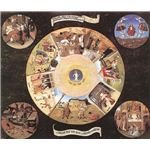 Others interpret the 7 rooms in "The Masque of the Red Death" as a symbol of Prospero's indulgence in the seven deadly sins:
- Pride/Vanity - Pride is the excessive belief in one's own abilities, similar to vanity, which is setting one's heart on things of little value. Prospero's belief that he is more powerful than death is a vivid demonstration of pride.
- Envy - It is unclear who the Prince might envy, but he sure is trying hard to impress someone.
- Gluttony - Gluttony is the act of consuming more than one is required. Instead of using his means to protect more people, something he is obligated to do as prince, he lavishes his guests with "ample provisions" and "the appliances of pleasure."
- Lust - Lust is an excessive craving for the pleasures of the body, usually associated with sex. The era in which Poe wrote prohibited the explicit or implicit description of sex, but what do you think was going on at an anything goes party?
- Anger - The Prince becomes angry with the uninvited guest and attacks it.
- Greed - Although it is apparent Prince Prospero shares his wealth with a thousand guests, he helps those who need it least and withholds his substance from those in need.
- Sloth - Sloth is the absence of work. The prince seems like a hard worker; his work, however, is on the physical realm not the spiritual realm.
- What do you think they mean? If you have an alternate interpretation, let me know in the comments.

References
- Poe, Edgar Allan. "The Masque of the Red Death." The Fall of the House of Usher and Other Tales. New York: Penguin, 1998. 145-51.
http://xroads.virginia.edu/~hyper/POE/masque.html
https://www.youtube.com/watch?v=UjrLFW0Y50I
Young Goodman Brown/The Birthmark
-->
AGENDA:
Play Sympathy for the Devil
"Sympathy For The Devil"
Please allow me to introduce myself
I'm a man of wealth and taste
I've been around for a long, long year
Stole many a man's soul and faith
And I was 'round when Jesus Christ
Had his moment of doubt and pain
Made damn sure that Pilate
Washed his hands and sealed his fate
Pleased to meet you
Hope you guess my name
But what's puzzling you
Is the nature of my game
I stuck around St. Petersburg
When I saw it was a time for a change
Killed the czar and his ministers
Anastasia screamed in vain
I rode a tank
Held a general's rank
When the blitzkrieg raged
And the bodies stank
Pleased to meet you
Hope you guess my name, oh yeah
Ah, what's puzzling you
Is the nature of my game, oh yeah
I watched with glee
While your kings and queens
Fought for ten decades
For the gods they made
I shouted out,
"Who killed the Kennedys?"
When after all
It was you and me
Let me please introduce myself
I'm a man of wealth and taste
And I laid traps for troubadours
Who get killed before they reached Bombay
Pleased to meet you
Hope you guessed my name, oh yeah
But what's puzzling you
Is the nature of my game, oh yeah, get down, baby
Pleased to meet you
Hope you guessed my name, oh yeah
But what's confusing you
Is just the nature of my game
Just as every cop is a criminal
And all the sinners saints
As heads is tails
Just call me Lucifer
Cause I'm in need of some restraint
So if you meet me
Have some courtesy
Have some sympathy, and some taste
Use all your well-learned politesse
Or I'll lay your soul to waste, um yeah
Pleased to meet you
Hope you guessed my name, um yeah
But what's puzzling you
Is the nature of my game, um mean it, get down
I'm a man of wealth and taste
I've been around for a long, long year
Stole many a man's soul and faith
And I was 'round when Jesus Christ
Had his moment of doubt and pain
Made damn sure that Pilate
Washed his hands and sealed his fate
Pleased to meet you
Hope you guess my name
But what's puzzling you
Is the nature of my game
I stuck around St. Petersburg
When I saw it was a time for a change
Killed the czar and his ministers
Anastasia screamed in vain
I rode a tank
Held a general's rank
When the blitzkrieg raged
And the bodies stank
Pleased to meet you
Hope you guess my name, oh yeah
Ah, what's puzzling you
Is the nature of my game, oh yeah
I watched with glee
While your kings and queens
Fought for ten decades
For the gods they made
I shouted out,
"Who killed the Kennedys?"
When after all
It was you and me
Let me please introduce myself
I'm a man of wealth and taste
And I laid traps for troubadours
Who get killed before they reached Bombay
Pleased to meet you
Hope you guessed my name, oh yeah
But what's puzzling you
Is the nature of my game, oh yeah, get down, baby
Pleased to meet you
Hope you guessed my name, oh yeah
But what's confusing you
Is just the nature of my game
Just as every cop is a criminal
And all the sinners saints
As heads is tails
Just call me Lucifer
Cause I'm in need of some restraint
So if you meet me
Have some courtesy
Have some sympathy, and some taste
Use all your well-learned politesse
Or I'll lay your soul to waste, um yeah
Pleased to meet you
Hope you guessed my name, um yeah
But what's puzzling you
Is the nature of my game, um mean it, get down
1.
Upon reading the short story and reading/listening to
the song, discuss the short story. What parallels are there to the short story?
Plot:
What was
Goodman Brown’s purpose in leaving that evening? Who did he meet on the trail
that evening? What did he learn about many of the ‘pious’ people of the town
that night?
Symbolism:
Snake staff,
Faith
Theme:
Why does
Goodman Brown yell out and stop the ‘ceremony’? How does he feel about the
people in town after that night? Why are his dying days ‘gloom’?
He is a
hypocrite of the worst sort. He shuns all in town for the own hypocrisy of
pretending to be pious by day but giving themselves to sin and the devil
willingly. However, he had gone there that night for the same purpose. He is
willing to fault others but never faults himself.
Questions: Do you agree
with Hawthorne’s grim vision of humanity in this story? Can people attain
goodness? What would it take? What could Brown have done to live a happier life
(one needs to admit their sins and forgive themselves before they may pray for
forgiveness).
The Birthmark:
-->
The Birthmark:
1.
Discuss the
elements of the story: Describe the character of Georgiana. Describe the
character of Aylmer. What does Georgiana’s birthmark symbolize? (pink =
innocence, the perfection of nature is found in the slight imperfections) How
does Aylmer respond to her birthmark after their marriage? How does this affect Georgiana? What does
that say about her character? After reading his journals, how does she
characterize his form of love? Why does he want the birthmark gone so badly?
What is the effect of its removal? Why?
2.
How are the
characters of Aylmer and Aminidab comparable? Students should be able to see
that they represent one human. Aminidab is referred to as an “earthly
creature,” a “lump of clay,” whereas Aylmer is referred to as “spiritual.” As
the story progresses, Aylmer makes the segregation wider, calling himself
God-like. Aminidab is also the only one that understands the beauty of the
birthmark. This can be seen as an attack on transcendentalism – Aylmer has
‘transcended’ above his bestial humanity (as the transcendentalists advocated)
and in doing so he rejected the world on its own terms. Human perfection is
impossible – something in us will not allow it (as Aylmer rejects the inner
perfection of Georgiana).
3. Science can unlock many mysteries, but should we draw a line? Should we try to
know everything? Because we are essentially flawed, the more we know the more
dangerous we become. What dangers exist and should we put constraints on
scientific advancement?
HMWK: Read "The Murders in the Rue Morgue" by Edgar Allan Poe
HMWK: Read "The Murders in the Rue Morgue" by Edgar Allan Poe
Tuesday, April 22, 2014
Rappaccini's Daughter, pt. 2
AGENDA:
TODAY WE WILL CONTINUE DISCUSSING "RAPPACCINI'S DAUGHTER" AND THE RELEVANCE OF ITS THEMES FOR OUR OWN TIMES. AT THE END OF CLASS, YOU SHOULD HAVE A DEEPER UNDERSTANDING OF THE KEY THEMES OF THIS STORY AND ITS ALLEGORICAL IMPLICATIONS FOR OUR OWN TIMES.
EQ: After close reading and analysis of the story, explore and evaluate the relevance of the following key ideas represented in Nathaniel Hawthorne’s 19c. short story “Rappaccini’s Daughter” have for the modern reader?
ACTIVITIES:
-->
- GROUP DISCUSSION (15 minutes): Assign groups to explore the following topics and chart their observations on chart paper to present to the class. Each group will pick an envelope and explore the topic contained in the envelope. Groups will use chart paper to record their observations.
Topics:
- Ethics and science (responsibility of scientists) Thematic
- Relationship between creator/inventor and creations/invention Thematic
- Relationships among families and friends Character analysis
- Impact of obsessions on self and others Character analysis
- Allegorical inversion: Metaphor of the “Garden of Eden” Rhetorical strategy
Turn in homework (packets)!
HMWK: Make sure you have read "The Birthmark" and "Young Goodman Brown" for tomorrow
Link to Fleetwood Mac song:
https://www.youtube.com/watch?v=38_M3ZdNDo4
Sunday, April 20, 2014
AP English Language MC Question Stems
From
its appearance, he judged it to be one of those botanic gardens which
were of earlier date in Padua than elsewhere in Italy or in the world.
Or, not improbably, it might once have been the pleasure-place of an
opulent family; for there was the ruin of a marble fountain in the
centre, sculptured with rare art, but so woefully shattered that it was
impossible to trace the original design from the chaos of remaining
fragments. The water, however, continued to gush and sparkle into the
sunbeams as cheerfully as ever. A little gurgling sound ascended to the
young man's window, and made him feel as if the fountain were an
immortal spirit that sung its song unceasingly and without heeding the
vicissitudes around it, while one century embodied it in marble and
another scattered the perishable garniture on the soil. All about the
pool into which the water subsided grew various plants, that seemed to
require a plentiful supply of moisture for the nourishment of gigantic
leaves, and, in some instances, flowers gorgeously magnificent. There
was one shrub in particular, set in a marble vase in the midst of the
pool, that bore a profusion of purple blossoms, each of which had the
lustre and richness of a gem; and the whole together made a show so
resplendent that it seemed enough to illuminate the garden, even had
there been no sunshine."
Imagery, symbolism, point of view
A Sampling of Typical Multiple Choice Question Stems
From Past AP
English Language & Composition Exams
Structure |
The structure
of…is marked by…
|
The syntax of the
sentence in lines…serves to…
|
Describe the
structure of the sentence in lines…
|
…is unified by
metaphorical references pertaining to…
|
As the sentence in
lines…is constructed,…is parallel to which of the following?
|
The speaker
describes…in an order best described as…
|
The pattern of
exposition exemplified in the passage is best described as…
|
Despite its
length,…remains coherent chiefly because of its use of…
|
In line…the use
of…instead of…accomplishes which of the following?
|
Which of the
following best describes the function of…in relation to…
Which
of the following best describes the function of the third paragraph in
relation to the two paragraphs that
precede it
|
Purpose |
What is the
speaker’s primary purpose in writing this passage?
|
Which of the
following best states the speaker’s purpose in lines…
|
The speaker
accomplishes all of the following EXCEPT…
|
In line…the author
emphasizes…because…
|
…is described
as…because it…
|
What is the
function of…introduced by…in line…
|
What is the effect
achieved by the speaker’s using the phrases…
|
Rhetorical Strategies |
What dominant
technique/rhetorical strategy is the speaker using in lines…
|
The
sentence…contains which of the following?
|
The main
rhetorical strategy in paragraph…is used in order to…
|
All of the
following may be found in the passage EXCEPT…
|
All of the
following qualities are present in the scene described in…EXCEPT…
The
function of the three clauses introduced by “that” in lines…is to…
Line…is
parallel to what other line in the passage?
|
Argument |
The author uses
which method to develop his argument?
|
The speaker’s
mention of…is appropriate to the development of the argument as an
illustration of..
|
The type of
argument employed by…is most similar to which of the following?
|
The author’s
discussion of…depends on which of the following?
|
Assertions/Beliefs |
In lines…, the
speaker/author asserts that…
|
The term…conveys
the speaker’s belief that…
|
Which of the
following is true about the various assertions made in the passage?
|
Which of the
following would the author be least likely to encourage in a person?
|
Contrast |
What contrast does
the speaker develop in lines…
|
The contrast
between…and…is based on…
|
Juxtaposing…and…serves
the purpose of…
|
In sentences…the
speaker develops or implies contrasts between all of the following EXCEPT…
|
Attitude |
The speaker’s
attitude toward…is best described as one of…
|
In…, which of the
following most suggests a…attitude on the part of the author?
|
The speaker
assumes that the audience’s attitude toward…will be one of…
|
Main Point |
The passage is
about…
|
Which of the
following best summarizes the main point in…
|
The overall point
in…involves which of the following?
The primary
comparison is between…
|
Style/Tone |
The style of the
passage is best characterized as (usually has paired adjectives or paired
tone nouns)
|
The tone of the
passage is…
|
The atmosphere
established in…is mainly one of…
|
Word/Phrase Meaning |
Which of the
following best restates the meaning of…
|
In lines…the
phrase...is used to refer to…
|
In…, the speaker
seeks to interest us in the subject of the discussion by stressing the…
|
Word/Phrase Meaning in Context |
In line…the
word…refers to…
The
phrase…functions primarily as…
|
In lines…”______”
is the metaphorical way of saying…
|
In context, all of
the following meanings are probably contained in…EXCEPT…
|
Grammar |
The antecedent
for…is…
|
The subject of the
sentence in lines…is…
|
Point of View |
The point of view
indicated in…is that of…
|
The shift in point
of view from…has the effect of…
|
Shifts |
A shift of tone
occurs in the passage in lines…
|
The phrase…signals
a shift from…to…
The
tone of the passage shifts from one of…to one of…
|
Misc.
|
In the
passage, the speaker makes all of the following assumptions about his/her
readers EXCEPT…
Which of the
following best describes the result of…
|
What is the effect
of…
|
It can be inferred
by…that…
|
In lines…the
speaker depicts himself as…
|
…is chiefly
remarkable for its…
|
The allusion…best
reflects the thought that…
|
According to the
passage,…is…because…
|
Finish the
analogy…
|
American Romanticism /"Rappaccini's Daughter"
American Literature: American Romanticism Overview
AGENDA:Today we will begin a 2 day lesson on Nathaniel Hawthorne's "Rappaccini's Daughter" and then continue with the other stories you were asked to read over the break.
Our goal is to address the following questions tomorrow.
EQ: After close reading and analysis of the story, explore and evaluate the relevance of the following key ideas represented in Nathaniel Hawthorne’s 19c.short story “Rappaccini’s Daughter” have for the modern reader?
1.
Ethics
and science (responsibility of scientists) Thematic
2.
Relationship
between creator/inventor and creations/invention Thematic
3.
Relationships
among families and friends Character analysis
4.
Impact
of obsessions on self and others Character analysis
5.
Allegorical
inversion of the “Garden of Eden” Rhetorical strategy
But first, let's take a moment to do a QUICKWRITE on your first reactions to "Rappaccini's Daughter". Post your responses on the blog (or use looseleaf paper period 9). Five minutes, GO!
Now let's take a look at American Romantics who are considered anti-Transcendentalists (or the Dark Romantics) because of their fascination with evil, death and the supernatural.
But first, let's take a moment to do a QUICKWRITE on your first reactions to "Rappaccini's Daughter". Post your responses on the blog (or use looseleaf paper period 9). Five minutes, GO!
Now let's take a look at American Romantics who are considered anti-Transcendentalists (or the Dark Romantics) because of their fascination with evil, death and the supernatural.
http://www.brighthubeducation.com/high-school-english-lessons/6429-notes-on-american-romanticism-class-handout/
- Romanticism in American Literature brought us some of the world's greatest writers. Edgar Allan Poe, Nathaniel Hawthorne, Herman Melville, Ralph Waldo Emerson, Washington Irving and Henry David Thoreau are still studied in classrooms throughout America and in Europe.
Romanticism
Romance describes strange lands and wonderful adventures. It allows the writer greater latitude to include the marvelous with the real. The romance may include the traditional hero with white hat on the white horse; the evil villain with the long black mustache; the lovely young woman in need of rescue, and the hairbreadth rescue itself. Romanticism as a movement began in the late 18th century, moved to England where it developed an emphasis in the glorification of nature, the supernatural, and the rebel—the individual against society. It spread to America in the early to mid 19th century and is represented in such writers as Hawthorne, Poe, and Cooper.American Romanticism
In the 1830’s, America began to experience the impact of the Romantic Movement that was transforming European civilization. Like the European movement of which it was an offshoot, American Romanticism was in a broad sense a new attitude toward nature, humanity, and society that espoused individualism and freedom. Many trends characterized American Romanticism. Among the most important are the following:
- An impulse toward reform (temperance, women’s rights, abolition of slavery)
- A celebration of individualism (Emerson, Thoreau)
- A reverence for nature (Cooper, Emerson, Thoreau)
- A concern with the impact of new technology (locomotive)
- An idealization of women
- A fascination with death and the supernatural (Hawthorne, Poe)
Important Writers
- Ralph Waldo Emerson (1803-1882): Self-Reliance
- Henry David Thoreau (1817-1862): Walden, Civil Disobedience
- Washington Irving (1783-1859): The Devil and Tom Walker, Rip Van Winkle Tales
- Edgar Allan Poe (1809-1849): The Pit and the Pendulum, The Masque of the Red Death, The Raven and many many more
- Nathaniel Hawthorne (1804-1864) The Scarlet Letter, The House of the Seven Gables, Doctor Heidegger’s Experiment, Young Goodman Brown
- And finally, working with partners, find specific evidence in the text to back up one of the following Discussion Points (Claims) made about the short story.
- Use the Conversation Roundtable template to find text evidence.
- HMWK: Correct your MP5 MC packets and hand in tomorrow during class.
Analysis of "Rappaccini's Daughter"
Discussion Points
- American Romanticism: The tenets of American Romanticism include the dangers of technology and a fascination with death and the supernatural. Rappaccini's unprioritized love for science and the supernatural aura surrounding Beatrice satisfy these aspects of American Romanticism.
- Characterization: "Rappaccini's Daughter" is a short story with no hero and no likable characters. Although we sympathize with Giovanni, his obsessive nature and unwillingness to listen to reason make him unlikeable. Beatrice endangers Giovanni's life. Rappaccini is a brilliant scientist but a lousy human. Pietro Baglioni appears to be the the voice of reason but acts treacherously to defeat his rival, as evidenced by his final comment and obvious jealousy.
- Allusions: References to the Garden of Eden, direct and indirect, abound.
- Symbolism: The poisonous plant and deteriorating statue in the center of the garden symbolize physical and moral corruption. The color purple, a hybrid color, symbolizes the mixing of ingredients and the mixing of good and evil in humans. Rappaccini's black clothing represents his diabolical nature.
- Setting and Mood: Hawthorne's physical description of the mansion and Giovanni's apartment help establish an ominous mood and foreshadows the story's tragic ending.
- Paradox: The controlling image of the story, the garden and Beatrice, is a paradox--a poisonous Eve and a poisonous Garden of Eden.
- Theme: Possible themes include the duality of human nature, the corrupting potential of science, lust, and jealousy.
More resources:
Subscribe to:
Posts (Atom)